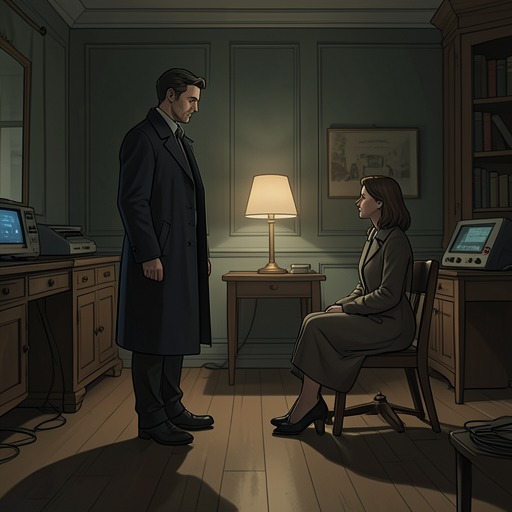
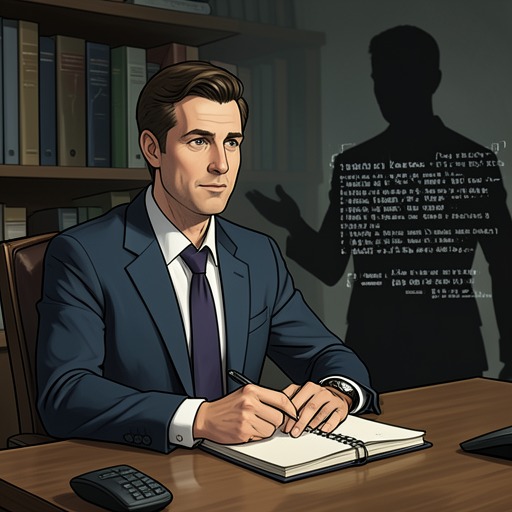
Mr. West
The Robot Who Looked Like MeMr. West is a large, glum, secretive accountant whose dependence on an inner Voice turns rational decision-making into an unsettling private system. The Voice has guided him successfully for years, but when it disappears amid unusual electrical and atmospheric conditions, West must face his own poor judgment—and the dangerous desires and decisions that his trusted adviser does not simply make harmless.
Identity and Decision-Making
Mr. West works for the New York accounting firm Adwell, Gipper and Gascoigne. He believes that everyone should make up his own mind rationally, and rejects the I Ching, Tarot cards, and horoscopes as irrational aids. Yet he does not, in practice, decide alone. He refers his problems to the Voice in his head, which tells him what to do and, by his experience, is always right.
The story gives this arrangement a concrete, almost mechanical image: West pictures the Voice as a miniature version of himself, about the size of a pea, seated in a brain compartment he imagines as Control Central. This little West looks out through the larger man’s senses, sorts out what he encounters, and makes decisions on his behalf. The setup divides West into the person who experiences a problem and the inner figure who resolves it, while preserving his conviction that his method is rational.
The Voice Falls Silent
The disruption begins during a week when engineers are testing generators in the newly built Conglomerate Building across the street from West’s apartment. The narration also notes unusually high sunspot activity, cosmic rays at a ten-year maximum, and a temporary four-degree shift in the Van Allen belts. These conditions coincide with the failure of West’s familiar decision-making system; the account associates them with the disturbance without establishing a definite cause.
When West asks what is happening, the Voice does not answer. Instead, he hears numerous other Voices saying strange things, including that he is destined to rule the solar system and has been trapped in a mortal body by evil pseudo-parents. West is alarmed not only by their bizarre content but by their multiplicity: one Voice has seemed normal to him, whereas many Voices suggest that he may be going crazy. Most troubling, he cannot reach his own particular adviser to ask what to do.
Decisions Without His Adviser
West tries to manage alone over the next few days. His investments immediately expose the limits of that effort: he sells Sweatshops, Ltd., which promptly rises five points, and buys Thanatopsis Corporation, which falls to a record low after Time announces that a new immortality serum is imminent. The losses are not presented as a complex financial crisis; their force lies in the direct contrast between West’s confidence in the Voice and his own unsuccessful choices when it is unavailable.
His other problem concerns Amelia, his fourteen-year-old niece, who is staying with him while her parents are in Europe. West recognizes the legal penalties for statutory incest-rape, but his thoughts turn to ways of assaulting her and evading responsibility. He considers entering her room in disguise, then imagines disguising an assault as sex education and relying on her disability to undermine her credibility in court. The episode exposes the danger beneath his reliance on an adviser: West’s need for guidance is not simply about ordinary uncertainty, and his unaided thinking reveals a willingness to exploit Amelia’s vulnerability.
Return and Consequences
West reads a newspaper feature about a religious colony on the northern slope of Mount Alluci in eastern Peru. Two dozen Americans have followed Elihu Littlejohn Carter, called the Last Prophet, to await the end of the world. Feeling numb and disoriented, West books a flight to Lima for the next day. The Voice returns as he puts down the telephone, immediately advising him that selling Sweatshops was a mistake and that doubling up on Thanatopsis could recover his position.
The miniature West says that he had been present all along but unable to establish a connection. He dismisses the apocalyptic material as irrational, consistent with West’s usual rejection of such beliefs, then turns to Amelia: he advises West to put two Nembutals in her Kool-Aid and leave the rest for later. West cancels his Peru trip. At the end of the month, Thanatopsis splits ten for one, confirming the Voice’s financial prediction; Amelia, meanwhile, is described as hooked on Nembutals. The return restores the adviser’s apparent authority, but its successful investment advice sits beside guidance that facilitates harm.
Narrative Role and Significance
West’s episode makes the boundary between rationality and dependence unstable. He rejects external systems of divination while treating a private Voice as a perfectly reliable decision-maker; its accuracy gives the arrangement credibility, but its unexplained absence leaves him unable to act competently. When it returns, it is vindicated by the stock split, yet that vindication cannot be separated from its advice about Amelia and the resulting drug dependence. The final insistence that every man follow his own inner Voice therefore lands as an ironic conclusion: West’s adviser may be right about the market, but reliability is not the same as moral judgment.